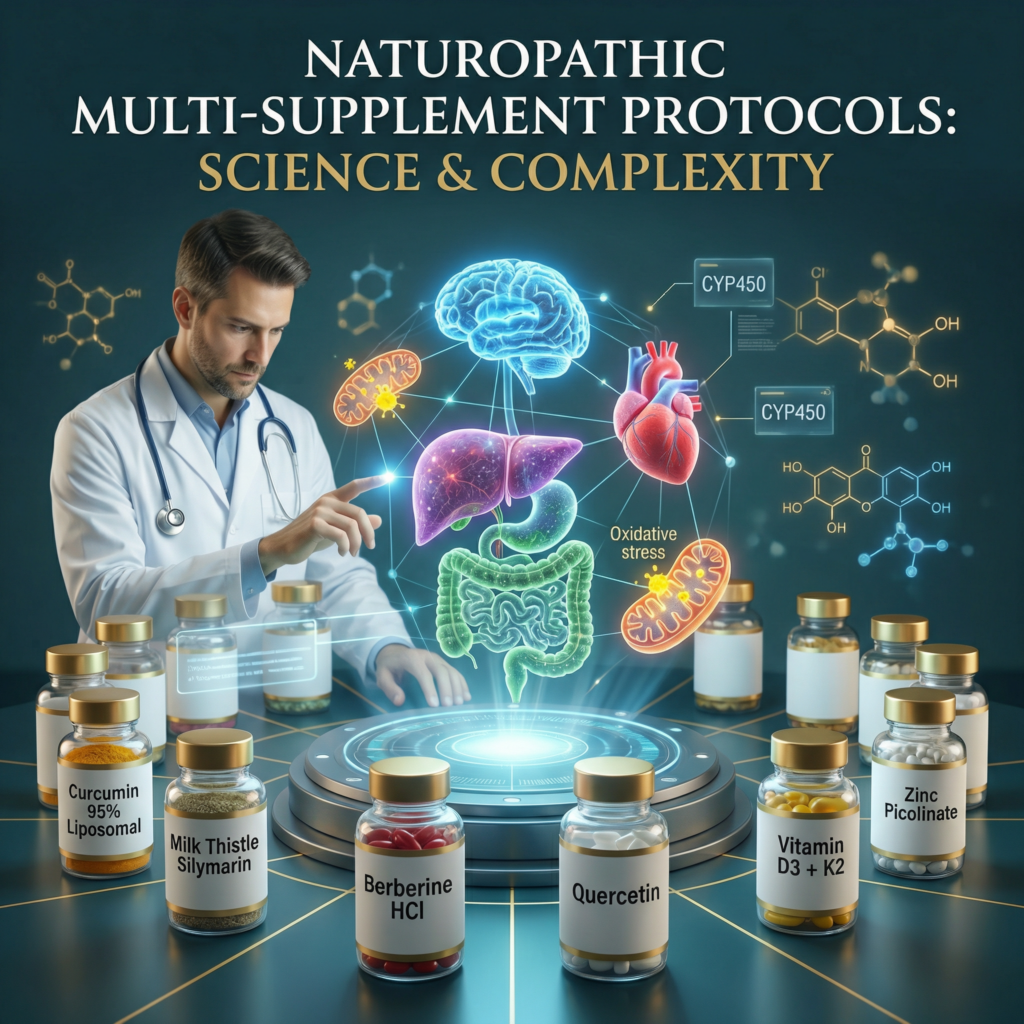
When patients are presented with a naturopathic supplement protocol containing multiple products, a natural and understandable reaction is to wonder: Why so many? This document explains the clinical reasoning behind multi-component protocols, the extensive training required to design them safely, the ways nutraceutical medicine differs fundamentally from pharmaceutical prescribing, and the real-world challenges: financial, informational, and scientific, that practitioners and patients navigate together. It also addresses, with honesty and intellectual humility, the situations in which supplements may not be the best approach, the dangers of health misinformation, and the time-intensive process of individualized protocol design.
I. The Complexity of Multi-Component Protocols: Effective Quantities and Quality
Why Multiple Supplements Are Often Necessary
A well-designed naturopathic protocol is not arbitrary. Each supplement targets a specific physiological pathway, biochemical process, or tissue system. Complex chronic conditions rarely involve a single dysfunction, they typically involve overlapping disruptions in inflammation, oxidative stress, detoxification, hormonal signaling, immune function, and nutrient metabolism. Addressing these systems requires multiple, carefully selected interventions rather than a single agent.
The Challenge of Effective Quantities
Unlike pharmaceutical drugs, which are well-defined chemical entities with established pharmacokinetics, botanical and nutraceutical ingredients are complex mixtures. A single herbal extract may contain multiple classes of bioactive compounds, many of which are poorly soluble in water, chemically unstable, or have high melting points that complicate formulation. For example, omega-3 fatty acids, curcumin, and carotenoids possess high nutritional and therapeutic value but are notoriously poorly absorbed without specialized delivery systems such as liposomal, nanoemulsion, or phospholipid-complexed formulations. These novel delivery systems improve efficacy but also increase cost, creating a practical tension between optimal and accessible dosing.
Getting the dose right is not straightforward. The bioavailability of a nutraceutical depends on the specific form used, the excipients in the formulation, timing of administration, and individual patient factors such as gut health, enzymatic activity, and concurrent medications. A product that delivers 500 mg of an ingredient on its label may deliver a vastly different amount of bioactive compound to the bloodstream depending on how it was manufactured.
Quality variability is one of the most critical and underappreciated issues in supplement medicine. A comprehensive review published in Nutrients noted that the most commonly observed quality problems include contamination, adulteration (inadvertent or intentional), and misleading labels. An international research collaboration including scientists from the NIH Office of Dietary Supplements, the USDA, and University College London emphasized that validated analytical methods, certified reference materials, and rigorous metrological approaches are essential to ensure dietary supplement quality, yet these standards are often underappreciated and underutilized in the industry.
Under the Dietary Supplement Health and Education Act (DSHEA) of 1994, the FDA does not have authority to approve dietary supplements before they are marketed. Manufacturers are responsible for evaluating the safety and labeling of their own products. This stands in stark contrast to pharmaceuticals, which must undergo extensive pre-market review including Phase I-III clinical trials. The result is that practitioners must exercise rigorous product selection, relying on third-party testing organizations (USP, NSF International, ConsumerLab) and professional-grade suppliers to ensure that what is on the label is actually in the bottle, and is free of contaminants.
II. The Extensive Training Required to Navigate This Complexity
Naturopathic Medical Education
Designing a safe and effective multi-supplement protocol is not something that can be learned from a weekend course, a certification program, or social media content. Licensed naturopathic doctors graduate from four-year, in-residence, graduate-level programs at accredited naturopathic medical schools, completing a minimum of 4,100 hours of class and clinical training, including over 1,200 hours of supervised hands-on clinical experience.
The curriculum mirrors much of conventional medical school in its first two years: anatomy, physiology, biochemistry, pathology, microbiology, immunology, and pharmacology, before diverging into specialized training in clinical nutrition, botanical medicine, physical medicine, counseling, and other naturopathic modalities. At the National University of Natural Medicine (NUNM), the program provides approximately 4,400 hours of total instruction including those 1,200+ clinical hours. Additional training in evidence evaluation, research methodology, and biostatistics teaches practitioners how to critically assess study quality and apply findings to clinical practice.
This does not include the prerequisite undergraduate education in sciences that is required before entering a naturopathic program, typically adding another four years of study. In total, becoming a licensed naturopathic doctor requires approximately eight years of post-secondary education.
Understanding Herb-Drug Interactions Requires Deep Pharmacological Knowledge
One of the most clinically consequential areas of expertise is understanding how botanical medicines and nutraceuticals interact with pharmaceutical drugs. A comprehensive review in Planta Medica documented the ability of ten commonly used medicinal herbs, including ginkgo, green tea, curcumin, ginseng, licorice, and rosemary, to modulate cytochrome P450 (CYP) enzymes and P-glycoprotein (P-gp), the two primary systems governing drug metabolism and transport. These herbs can act as both inhibitors and inducers of various CYP isoforms, meaning they can either increase or decrease the blood levels of concurrent medications, with potentially serious clinical consequences.
Understanding these interactions requires knowledge of CYP450 enzyme families (1A2, 2C9, 2C19, 2D6, 3A4) and their role in drug metabolism; P-glycoprotein transport and its effect on drug absorption and distribution; Phase II conjugation pathways (glucuronidation, sulfation, methylation); the pharmacokinetics of individual botanical constituents; and patient-specific variables including genetics (pharmacogenomics), liver function, and concurrent medications.
III. How Nutraceutical and Herbal Dosing Differs from Pharmaceutical Approaches
Single-Molecule vs. Complex Phytocomplex
The fundamental distinction between pharmaceutical and nutraceutical dosing lies in molecular complexity. A pharmaceutical drug is typically a single, well-characterized molecule with thoroughly studied pharmacokinetics. Botanical medicines and nutraceuticals are inherently different. They are complex mixtures containing dozens to hundreds of bioactive constituents. An herbal extract may contain multiple classes of compounds, alkaloids, flavonoids, terpenoids, saponins, that act synergistically. The therapeutic effect often depends on the entire phytocomplex, not just a single isolated constituent.
Bioavailability Is Highly Variable
The bioavailability challenges of nutraceuticals are fundamentally different from those of pharmaceuticals. Many key nutraceutical compounds, curcumin, resveratrol, quercetin, CoQ10, have inherently poor oral bioavailability due to low aqueous solubility, rapid first-pass metabolism, or chemical instability. This means the same "dose" in milligrams can produce wildly different blood levels depending on the specific chemical form, whether the product includes bioavailability enhancers, the patient's individual gut health, enzyme activity, and microbiome composition, and timing relative to meals and other supplements.
IV. Disease Complexity Demands Protocol Complexity
The Principle of Multi-System Dysfunction
A patient with a straightforward, isolated nutritional deficiency may need only a single supplement. But most patients seeking naturopathic care present with complex, chronic conditions involving multiple overlapping pathophysiological mechanisms. Consider a patient with metabolic syndrome: they may simultaneously have insulin resistance, dyslipidemia, chronic low-grade inflammation, oxidative stress, gut dysbiosis, elevated cortisol, and fatty liver. Each of these mechanisms feeds into and amplifies the others, creating a web of dysfunction that cannot be untangled with a single intervention.
Research has established that chronic diseases involve cascading disruptions: mitochondrial dysfunction generates excessive reactive oxygen species (ROS), which triggers oxidative stress, which activates inflammatory signaling pathways including NLRP3 inflammasome, which further damages mitochondria, creating a self-reinforcing cycle of cellular damage. Addressing this requires interventions at multiple points in the cascade.
The Goal Is Not "More": It Is "Targeted"
The goal of a multi-supplement protocol is never to prescribe the maximum number of products. It is to identify the minimum effective intervention for each relevant pathway. As the patient improves, protocols are reassessed and simplified. Some supplements are foundational (ongoing support), while others are therapeutic (time-limited interventions addressing acute dysfunction).
V. The Financial Reality: Supplements vs. Insured Pharmaceuticals
One of the most significant and honest conversations that must happen in naturopathic practice is about cost. Dietary supplements are almost universally not covered by health insurance, including Medicare. Patients bear the full out-of-pocket expense. A 2025 study examining the cost burden of dietary supplements in older adults found that the mean annual cost among supplement users was $186 as a conservative estimate, with individual monthly costs ranging from $0.73 to $174.80. Patients on complex, multi-agent naturopathic protocols may spend significantly more, often $150-$400+ per month depending on the number and quality of products prescribed.
By contrast, generic pharmaceutical medications are often remarkably affordable with insurance. A 2024 cost-effectiveness analysis published in Exploratory Research in Clinical and Social Pharmacy directly compared the cost per mg/dL reduction in LDL cholesterol between generic pravastatin and dietary supplement alternatives. Even without insurance, pravastatin was the most cost-effective option. With a standard generic copay of approximately $6.06/month, pravastatin became dramatically more cost-effective: approximately $0.10 per mg/dL of LDL reduction compared to $0.81-$0.88 for supplement alternatives that have no insurance coverage option.
The financial pressures facing patients are real and must be taken seriously. Approximately one in five American adults have not filled a prescription due to cost. Financial accessibility must be part of clinical decision-making. Practitioners have an obligation to discuss cost openly and without judgment, prioritize interventions by clinical impact, identify when a pharmaceutical option is more cost-effective and clinically appropriate, and revisit protocols regularly to eliminate products that are no longer necessary.
VI. When Supplements Are the Worse Approach: Intellectual Honesty in Practice
The Red Yeast Rice vs. Statin Example
Perhaps no example better illustrates the need for intellectual honesty than the comparison between red yeast rice (RYR) and statin medications for cholesterol management. Red yeast rice's primary active compound, monacolin K, is chemically identical to the prescription drug lovastatin. When patients take red yeast rice for cholesterol, they are essentially taking an unregulated, unstandardized form of a statin drug, but without the quality controls, dosing precision, or insurance coverage that come with a prescription.
A landmark study published in Archives of Internal Medicine tested 12 commercial RYR products and found striking variability: total monacolin content ranged from 0.31 to 11.15 mg per capsule, and monacolin K (lovastatin) ranged from 0.10 to 10.09 mg per capsule, a nearly 100-fold difference. Even more concerning, one-third of the products tested contained detectable levels of citrinin, a mycotoxin that is nephrotoxic in animal studies.
A subsequent European study screening 37 RYR food supplements found citrinin in every single product tested, with concentrations ranging from 100 to 25,100 ug/kg. Four products labeled "citrinin free" were in fact contaminated. No sample met pharmaceutical Good Manufacturing Practice requirements for label accuracy.
Other Scenarios Where Supplements May Underperform
Situations where pharmaceutical interventions may be clearly superior include: acute infections requiring antibiotics, where herbal antimicrobials alone may be insufficient; severe depression or anxiety where SSRIs or other medications provide more rapid and reliable stabilization than nutraceuticals alone; poorly controlled diabetes where metformin or insulin are essential and cannot be safely replaced by berberine or chromium alone; and acute cardiovascular events where anticoagulants, antihypertensives, and statins have life-saving evidence. A naturopathic approach should never be dogmatically "anti-pharmaceutical." Good medicine uses the best tool for the job.
VII. Misinformation, Scope of Knowledge, and the Dunning-Kruger Effect
The Current Landscape of Health Misinformation
The health and wellness space is currently flooded with misinformation, much of it propagated by individuals who lack the training to understand the complexity of what they recommend. Social media has created an unprecedented platform for this phenomenon. An analysis published in The BMJ in 2025 found that more than 70% of young adults in the U.S. follow health-related influencers, and over 40% have purchased products based on their recommendations. The authors identified four primary sources of bias in influencer health advice: lack of medical expertise, industry influence, entrepreneurial interests, and personal beliefs.
The consequences are not theoretical. During the COVID-19 pandemic, global health misinformation networks generated 3.8 billion views on Facebook in a single year. False health news stories on Twitter were found to be 70% more likely to be shared than true ones, and true stories took six times longer to reach the same audience. Survey data suggest that nearly 1 in 5 Americans now trust health influencers more than medical professionals in their community, and half of Americans have purchased a health product after seeing a social media advertisement.
The Dunning-Kruger Effect in Health and Wellness
The disconnect between confidence and competence in the wellness space is well described by the Dunning-Kruger effect, a cognitive bias first identified by psychologists David Dunning and Justin Kruger at Cornell University in 1999. The effect describes the systematic tendency of people with limited ability or knowledge in a specific area to significantly overestimate their competence in that area. Critically, this bias includes a "dual burden": not only do individuals with limited knowledge make errors, but they also lack the metacognitive ability to recognize those errors.
In simpler terms: the less you know about a subject, the harder it is to recognize how much you don't know. Conversely, true experts tend to underestimate their relative competence because they are acutely aware of the complexity and uncertainty in their field. This effect is pervasive in health and wellness spaces. Individuals who have completed a short certification or consumed significant social media content may feel highly confident in their ability to recommend supplement protocols, precisely because they don't have enough knowledge to appreciate the complexity of pharmacokinetics, herb-drug interactions, individual variability, and quality assessment that makes this work genuinely difficult and potentially dangerous when done poorly.
VIII. The Time and Complexity of Individualized Protocol Design
Three Pillars of Evidence in Naturopathic Practice
Designing a naturopathic supplement protocol requires the synthesis of three distinct bodies of knowledge: Population-Based Research (systematic reviews, meta-analyses, RCTs that establish whether an intervention works on average in a studied population); Traditional Usage and Historical Context (centuries of systematic observation in Traditional Chinese Medicine, Ayurveda, Western herbalism, and indigenous healing traditions); and Individualized Patient Assessment (genetics and pharmacogenomics, current health status, medication list, digestive function, financial constraints, lifestyle factors, and patient goals and preferences).
This process is time-intensive. Naturopathic doctors typically spend one to two hours with patients in an initial appointment and 30 to 60 minutes in follow-up visits, compared to an average of approximately 20 minutes in a conventional doctor's appointment. This extended time is not a luxury, it is a clinical necessity for gathering the detailed history, reviewing labs, evaluating current medications and supplements, assessing interactions, and designing an individualized protocol.
The multi-supplement naturopathic protocol is not a product of carelessness or salesmanship. It is a reflection of the genuine complexity of human physiology, the multi-system nature of chronic disease, and the current state of nutraceutical science and regulation. It requires extensive training to do well, carries real financial implications that must be addressed honestly, and must be held to the same standard of intellectual honesty as any other medical intervention, including the willingness to recommend pharmaceutical options when they are clearly superior.
At its best, naturopathic medicine offers something powerful: a deeply individualized, evidence-informed approach to health that treats the whole person rather than isolated symptoms. But this power comes with responsibility: the responsibility to stay current with the evidence, to be transparent about limitations and costs, to respect the boundaries of knowledge (both our own and others'), and to always put the patient's wellbeing ahead of any ideology.