When Descartes called the pineal gland the seat of the soul, he was reaching, perhaps a little awkwardly, for something the science of his day could not yet name. He sensed that this tiny pinecone-shaped structure tucked deep in the brain held a kind of central authority over the body's inner life. Modern endocrinology has softened the metaphor but not entirely overturned it. The pineal is now understood as our master clock... the conductor of melatonin secretion, the keeper of circadian rhythm, and the gland that, perhaps tellingly, calcifies and quiets earlier than almost any other tissue in the human body...
Forty years ago, a Russian biogerontologist named Vladimir Khavinson became fascinated with the idea that the pineal might also be a source of small peptide signals that influence aging itself. Out of that work came Epitalon, also known as Epithalon or AEDG. It is a synthetic tetrapeptide made of just four amino acids: alanine, glutamic acid, aspartic acid, and glycine. Four letters. A short sentence written in the alphabet of life. And yet this brief molecular phrase has been studied for decades for its capacity to influence telomere maintenance, antioxidant defense, circadian rhythm, and gene expression itself.
The longevity world has fallen in love with Epitalon for understandable reasons. Most so-called anti-aging interventions work downstream... calming inflammation, supporting mitochondria, or feeding a tired pathway. Epitalon appears to work much closer to the blueprint, influencing not just how the body operates but what its cellular blueprints are quietly transcribing. That is the source of its appeal, and also the source of the questions we should ask carefully.
1. Telomerase and the Protective Caps of the Chromosome
Every chromosome ends in a protective cap called a telomere. You can picture them as the small plastic aglets at the ends of your shoelaces. As cells divide, those caps shorten. When they grow too short, the cell either stops dividing or quietly walks itself toward death. This is part of why our skin, our blood, and our brain lose their adaptive resilience with time.
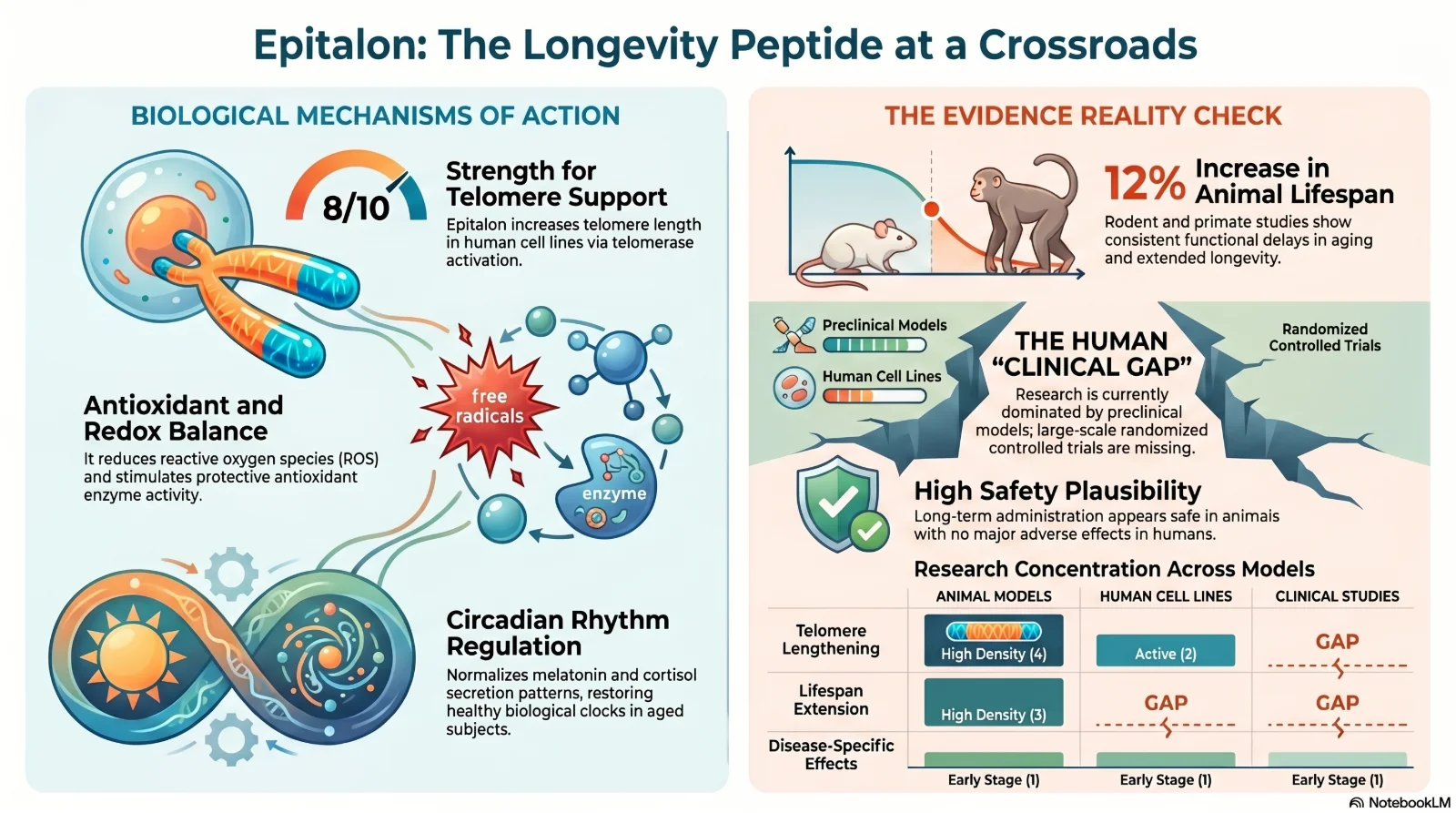
Telomerase is the enzyme responsible for extending and maintaining those caps. Most adult cells produce very little of it. Epitalon, according to a growing body of cell-line work, can upregulate hTERT, the catalytic engine of telomerase, and meaningfully lengthen telomeres in human cells in vitro (Al-Dulaimi et al., 2025). A recent review even suggests that Epitalon may activate the alternative lengthening of telomeres (ALT) pathway in certain cancer cell lines, which is an important caveat I will return to in a moment.
The Consensus literature review rates this mechanism as Strong in terms of evidence quality. It is, by far, the most clearly demonstrated of all of Epitalon's effects in human cells. Mechanism plausible. Mechanism replicated. Mechanism dose-dependent.
2. A 12% Lifespan Extension in Animals... and What That Means (and Doesn't)
In rodents and non-human primates, decades of work have shown that Epitalon administration consistently extends maximum lifespan by approximately 12% (Anisimov et al., 2003; Khavinson & Morozov, 2002). It has also been associated with reduced chromosomal aberrations, delayed age-related decline in reproductive function, and a more stable metabolic profile in aging animals.
One finding that does not get much attention in the popular conversation is worth pausing on. In those same animal studies, Epitalon inhibited the development of leukemia without increasing the overall incidence of tumors. This is meaningful because telomerase activation is one of the legitimate concerns raised by oncologists when peptides like this are discussed. Cancer cells exploit telomerase to escape their normal lifespan. The animal data are reassuring, but they are not a guarantee, and they do not let us off the hook of careful individual screening before starting a protocol...
It is also worth being honest that 12% is not, as some online sources suggest, a translation to twelve extra years of human life. Animal lifespan curves do not transfer to humans in any direct or guaranteed way. The relevant question is whether the same biological levers that extend mouse lifespan also support human healthspan, the time we live with vigor and clarity. The current best answer to that question is: probably yes, possibly, and the data are still maturing.
3. Re-tuning the Master Clock
The pineal gland is the body's chronobiological conductor. Its rhythm shapes every other rhythm... cortisol, growth hormone, body temperature, sleep architecture, and even the cellular repair cycles that depend on darkness. With age, this conductor grows quieter. The orchestra plays on, but a little less in time with itself.
Epitalon appears to help restore some of that timing. In aged primates and elderly humans with pineal insufficiency, it has been shown to normalize melatonin secretion patterns and circadian cortisol rhythms (Korkushko et al., 2007; Trofimova et al., 2025). Patients on Epitalon protocols often notice vivid dreams during the first few nights of a course. We tell them this is expected... a small, lit-up signal that the pineal is awake and listening.
There is also early evidence that Epitalon may support retinal health, particularly under hyperglycemic conditions like those seen in diabetic retinopathy (Gatta et al., 2025). The eye and the pineal are developmentally cousins, both descended from ancestral light-sensing tissue, and it is biologically tidy that a peptide that influences one might also support the other.
4. Antioxidants, Epigenetics, and the Quiet Work of Neurogenesis
Beyond telomere biology and circadian re-tuning, Epitalon appears to do quieter work at the level of antioxidant defense and gene expression. It increases superoxide dismutase and other endogenous antioxidant enzymes, reduces reactive oxygen species, and protects mitochondrial function in aging pineal and thymic cells (Kozina et al., 2007; Yue et al., 2022).
It also appears to interact with the epigenetic machinery itself, influencing how neurogenic genes are expressed and supporting neural stem cell differentiation (Khavinson et al., 2020; Ivko et al., 2021). The pineal's reach, in other words, may extend further into the body's gene-regulatory architecture than its small size would suggest. So it is with us... what looks small from the outside sometimes carries the most quiet authority.
5. The Honest Limits of What We Know
I want to be clear about something. Most of the foundational Epitalon research originates from a small cluster of institutes in Russia and Ukraine, much of it from Khavinson's group at the St. Petersburg Institute of Bioregulation and Gerontology. This is not, in itself, a reason to dismiss the work. Khavinson has published for decades in peer-reviewed journals, and many of the findings have been replicated in cellular models. But it is a reason to ask for more.
The Consensus literature review summarizes the state of the evidence well: mechanism strong, animal data moderate, human clinical data weak. There are no large-scale randomized controlled trials. There are no FDA-approved indications. Epitalon remains an investigational peptide that we use in clinical practice with eyes open, after a careful individual review, and as part of a longevity-oriented protocol that includes the rest of life... sleep, food, breath, movement, and relationship. Vis Medicatrix Naturae. The healing power of nature. Peptides like Epitalon are interesting precisely because they speak the body's native molecular language. But the body also needs us to attend to the rest of its conversation, not only one particular sentence.
6. The Protocol in Practice
Epitalon is administered as a subcutaneous injection, typically at bedtime to align with the natural pineal rhythm. There are three common research-derived protocols used in clinical practice:
- Russian Protocol: 10 mg daily for 10 days (100 mg total per course)
- Ukrainian Protocol: 10 mg per dose, 5 doses spread across 17 days (50 mg total)
- Extended Protocol: 5 mg daily for 20 days (100 mg total)
The 4 to 6 month rest period between courses is not arbitrary. It is built into the original Russian research design, and the working theory is that the biological effects of bioregulator peptides need time to be fully expressed and consolidated by the body's own systems. We do not run back-to-back courses.
A few practical details that are good to know:
- Rotate injection sites nightly among the lower abdomen, outer thigh, and upper arm to avoid local irritation.
- Refrigerate vials at 2 to 8 degrees Celsius. Protect from light. Use within 30 days of opening.
- Expect vivid dreams. Welcome them. Consider it part of the conversation with the pineal.
- If you have any personal history of cancer or current oncologic concerns, please... please... do not begin Epitalon without an individual review with your oncology team. Telomerase is also a tool that cancer cells use. The animal data are reassuring, but they do not replace personalized clinical judgment.
A Closing Reflection
We are living through a moment in medicine when the language of repair is becoming molecular. We are learning to whisper at the level of the chromosome itself. That is genuinely exciting... it really is. But every new tool comes with a quiet responsibility to remember what it cannot do.
Epitalon cannot replace good sleep. It cannot undo a chronically inflamed diet. It cannot heal a relationship or quiet a restless soul. It is a small molecule with a specific job, sent into a body whose well-being depends on far more than the integrity of its telomeres.
What Epitalon can do, when used thoughtfully and in the right person at the right time, is help re-tune the master clock that the pineal has been carrying since we were children. And in doing so, perhaps it offers us a little more time... and a little more depth to the time we already have.
The healing power of nature is patient. So is the body. So, in the end, are we.
Disclaimer:
This article is for educational purposes only and does not constitute medical advice. Epitalon is an investigational peptide with no FDA-approved indications. All clinical use is off-label and should be individually reviewed and supervised by a qualified medical provider. Please consult your physician before starting any peptide protocol, particularly if you have a history of cancer or are taking other medications.
References
Al-Dulaimi, S., Thomas, R., Matta, S., & Roberts, T. (2025). Epitalon increases telomere length in human cell lines through telomerase upregulation or ALT activity. Biogerontology, 26. https://doi.org/10.1007/s10522-025-10315-x
Anisimov, V., Khavinson, V., Popovich, I., Zabezhinski, M., Alimova, I., Rosenfeld, S., Zavarzina, N., Semenchenko, A., & Yashin, A. (2003). Effect of Epitalon on biomarkers of aging, life span and spontaneous tumor incidence in female Swiss-derived SHR mice. Biogerontology, 4, 193-202. https://doi.org/10.1023/a:1025114230714
Araj, S., Brzezik, J., Madra-Gackowska, K., & Szeleszczuk, L. (2025). Overview of Epitalon: Highly bioactive pineal tetrapeptide with promising properties. International Journal of Molecular Sciences, 26. https://doi.org/10.3390/ijms26062691
Gatta, M., Dovizio, M., Milillo, C., Ruggieri, A., Sallese, M., Antonucci, I., Trofimov, A., Khavinson, V., Trofimova, S., Bruno, A., & Ballerini, P. (2025). The antioxidant tetrapeptide Epitalon enhances delayed wound healing in an in vitro model of diabetic retinopathy. Stem Cell Reviews and Reports, 21, 1822-1834. https://doi.org/10.1007/s12015-025-10911-x
Ivko, O., Drobintseva, A., Leont'eva, D., Kvetnoy, I., Polyakova, V., & Linkova, N. (2021). Influence of AEDG and KE peptides on mitochondrial staining and the expression of ribosomal protein L7A with aging of the human pineal gland and thymus cell in vitro. Advances in Gerontology, 11, 261-267. https://doi.org/10.1134/s2079057021030061
Khavinson, V. (2002). Peptides and ageing. Neuroendocrinology Letters, 23 Suppl 3, 11-144.
Khavinson, V., Diomede, F., Mironova, E., Linkova, N., Trofimova, S., Trubiani, O., Caputi, S., & Sinjari, B. (2020). AEDG peptide (Epitalon) stimulates gene expression and protein synthesis during neurogenesis: Possible epigenetic mechanism. Molecules, 25. https://doi.org/10.3390/molecules25030609
Khavinson, V., & Morozov, V. (2002). Geroprotective effect of thymalin and epithalamin. Advances in Gerontology, 10, 74-84.
Korkushko, O., Lapin, B., Goncharova, N., Khavinson, V., Shatilo, V., Vengerin, A., Antoniuk-Shcheglova, I., & Magdich, L. (2007). Normalizing effect of the pineal gland peptides on the daily melatonin rhythm in old monkeys and elderly people. Advances in Gerontology, 20(1), 74-85.
Kozina, L., Arutjunyan, A., & Khavinson, V. (2007). Antioxidant properties of geroprotective peptides of the pineal gland. Archives of Gerontology and Geriatrics, 44 Suppl 1, 213-216. https://doi.org/10.1016/j.archger.2007.01.029
Trofimova, S., Kuznetsova, T., & Trofimov, A. (2025). Effects of short peptides on the molecular mechanisms of aging in laboratory primates. Molekulyarnaya Meditsina (Molecular Medicine). https://doi.org/10.29296/24999490-2025-06-09
Yue, X., Liu, S., Guo, J., Meng, T., Zhang, X., Li, H., Song, C., Wang, Z., Schatten, H., Sun, Q., & Guo, X. (2022). Epitalon protects against post-ovulatory aging-related damage of mouse oocytes in vitro. Aging (Albany NY), 14, 3191-3202. https://doi.org/10.18632/aging.204007