For most of human history, aging has been viewed as a one-way street, a predictable and unstoppable process of decline. We count the years, watch for gray hairs, and accept that with each passing birthday, our bodies will inevitably become slower, weaker, and more prone to disease. This traditional view frames aging as a fixed timeline, a chronological countdown that we can do little to influence beyond managing the symptoms of its final, difficult stages.
This long-held paradigm is now collapsing under the weight of scientific evidence. Modern geroscience, which is the study of the biology of aging, is revealing a radically different story. Scientists now understand aging not as a matter of time, but as a specific set of biological processes that can be measured, targeted, and modified. The new science of longevity is not about simply extending life, but about extending our years of vibrant health. This article will explore five of the most impactful revelations from this field that are completely changing our relationship with growing older.
1. Your "Real" Age Can Be Reversed
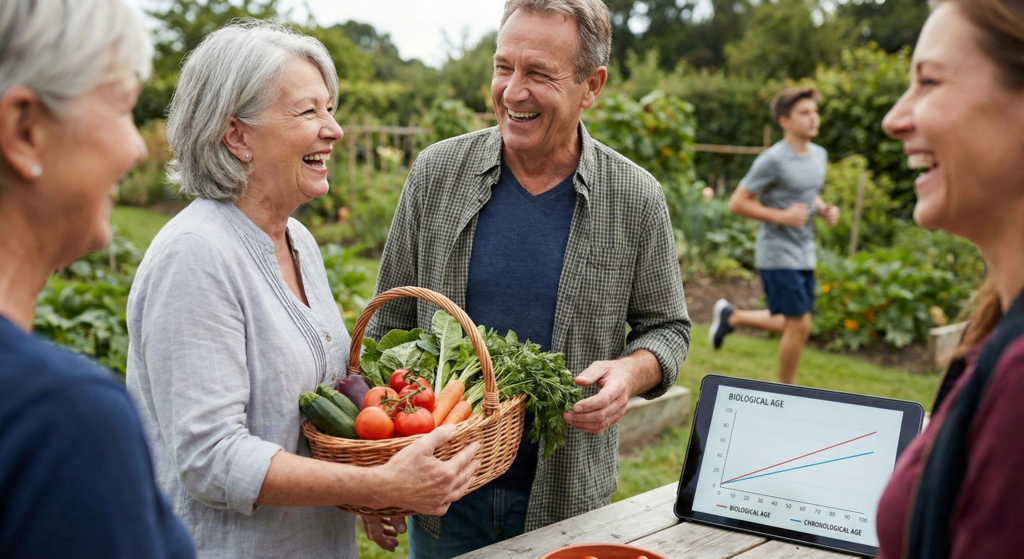
The number of candles on your birthday cake is your chronological age, a simple, unchangeable count of the years since you were born. But a far more important number is your biological age, which is an indicator of how well your body is functioning. It is a precise measure of your health based on biomarkers in your blood and the epigenetic patterns on your DNA (known as "epigenetic clocks"). While genetics account for 20-30% of this aging variability, the rest is highly modifiable.
The most powerful evidence of this malleability comes from recent human trials. A landmark 2021 study by Fitzgerald et al. demonstrated that an intervention including diet, sleep, and exercise reversed the DNA methylation age of adult males by an average of 3.23 years. More recently, research from the USC Longevity Institute found that just three cycles of a fasting-mimicking diet reduced participants' biological age by 2.5 years. The clinical implications are staggering: for every five years a woman's biological age exceeds her chronological age, her risk of breast cancer increases by 15%. This revelation is transformative because it shifts control from an unchangeable number to a manageable health state that responds directly to our choices.
2. We've Been Fighting Aging All Wrong
For decades, the traditional medical model has treated age-related diseases like cancer, heart disease, diabetes, Alzheimer's as separate, unrelated problems. This reactive approach, which the geroscience community calls "whack-a-mole," waits for a disease to appear and then tries to manage it. While this has extended lifespan, it has left many people suffering from multiple chronic conditions in their later years.
The "Geroscience Hypothesis" offers a revolutionary new paradigm. It posits that aging itself is the single greatest risk factor for nearly all chronic diseases. Instead of treating each disease individually, this new approach targets the underlying biological mechanisms of aging. By doing so, we can delay the onset of multiple diseases at the same time.
The central insight is captured perfectly in a seminal 2014 paper published in the journal Cell: "By therapeutically targeting the biological mechanisms of aging itself, the onset of multiple age-related diseases can be delayed simultaneously (Kennedy et al., Cell 2014)."
This represents a fundamental reorientation of medicine, moving from reactive disease management toward the proactive fortification of our entire biological system.
3. "Zombie Cells" Are Real (And They're Aging You From the Inside)
Our bodies have a powerful defense mechanism called Cellular Senescence. When a cell suffers DNA damage or is at risk of becoming cancerous, it can enter a state of permanent arrest where it stops dividing. Crucially, these cells don't die; they remain metabolically active.
This is an antagonistic, or biphasic, process. In youth, it's incredibly beneficial, helping to prevent cancer and assist in wound healing. However, as we age, these "zombie cells" accumulate. Instead of dying off, they linger and begin secreting a toxic cocktail of inflammatory signals known as the Senescence-Associated Secretory Phenotype (SASP). This creates a state of chronic, low-grade inflammation that damages surrounding healthy tissue, impairs stem cell function, and actively promotes the development of age-related diseases.
This discovery is so profound because it identifies a specific, targetable culprit driving systemic aging. It also identifies an entirely new class of therapies called "senolytics", such as the combination of Dasatinib and Quercetin, that are now being developed to specifically find and eliminate these harmful cells.
4. Your Social Life Is a Biological Lever
In a stunning validation of the mind-body connection, psychosocial factors are now being seriously considered as a proposed new hallmark of aging. Research now proves what many have long suspected: social isolation, loneliness, and chronic stress are not just emotionally painful, they are biologically damaging and actively accelerate the aging process.
The biological evidence is clear and direct. Social adversity has been shown to activate the pro-inflammatory NF-κB pathway, a key driver of chronic inflammation. A large meta-analysis of 90 different cohort studies confirmed that loneliness is a potent risk factor for premature mortality from all causes. This is a profound takeaway because it scientifically validates the deep, inseparable connection between our mental well-being and our physical healthspan, transforming "soft" wellness advice into a hard biological imperative.
5. The Future of Aging is a Choice
The biological narrative of aging is being rewritten. It is no longer an inevitable fate but a malleable process that we can actively influence. The wall between chronological time and biological health has been torn down, revealing that the core mechanisms of aging are responsive to our actions.
This new knowledge confers an unprecedented degree of agency over our healthspan. Our daily choices, from the food on our plate to the quality of our sleep, determine whether we accumulate zombie cells, whether we fortify our defenses against chronic disease, and whether our social bonds become a source of biological resilience. The future of aging is not something that happens to us; it is something we can help create.
Now that you know your biological age is not fixed, what choices will you make today to invest in your future self?