The Allure of the Miracle Molecule
I'll be honest with you… I love peptides. I've written about BPC-157 with genuine excitement, sent emails to colleagues with multiple exclamation marks about the brain-gut axis benefits, and spent hours geeking out over the mechanisms. So when I tell you that the current peptide market has some serious problems, understand that this isn't coming from a place of skepticism about the molecules themselves. It's coming from a place of caring about the people injecting them.
In the hyper-optimized world of modern longevity, peptides like BPC-157 and TB-500 have ascended to near-mythical status. Championed by high-profile influencers and wellness advocates as "miracle" healing agents, these compounds promise to repair tendons and tissues with a speed that makes traditional medicine look like it's still using dial-up internet.
And some of them genuinely show promise. The science is fascinating.
But here's where my training in chemistry and biology starts waving red flags… beneath the anecdotal success stories lies a profound biological gap. The enthusiasm for these molecules is built almost entirely on preclinical animal data. And if there's one thing I learned during my years in integrative oncology… watching promising lab results crash and burn in human trials… it's that the leap from rat to human is less of a hop and more of a canyon crossing without a bridge.
When a product is labeled "unapproved," that isn't a bureaucratic inconvenience. It's a warning that the most critical tests for human safety have been bypassed entirely. As someone who spends his clinical life synthesizing biological complexity for patients, I see a market where the excitement for "biohacking" has outpaced our understanding of the long-term cellular consequences. To understand the gamble, we have to peel back the curtain on what actually happens when we skip the safety signals that protect us.
The "Phase 3" Gap… It's Not Just Paperwork
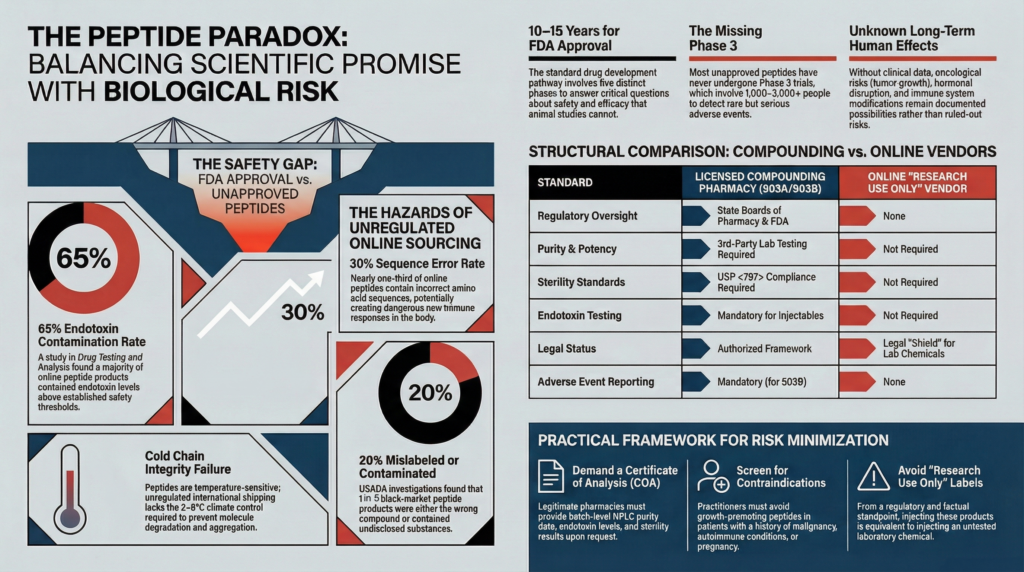
The road to FDA approval is a rigorous 10 to 15 year journey, and there's a good reason for that timeline. Biological systems are profoundly difficult to predict. Most plants require both light and dark to meet their furthest growth potential… so it is with drugs. They need the full spectrum of testing to reveal their true nature, both the healing and the harm.
This process is the only reliable way to identify rare but devastating side effects that only emerge in large, diverse populations. Think about it… you can test something on 50 people and everything looks golden. Test it on 3,000 and suddenly a pattern emerges that nobody saw coming.
Most trending peptides have stalled early in this journey. While animal studies may show activity, they lack the scrutiny of Phase 3 clinical trials… the stage involving 1,000 to 3,000+ participants. This is where the majority of drugs fail. Without this data, we remain blind to what I'd call "fundamental biological unknowns."
Here's an example that keeps me up at night. BPC-157 operates through a pro-angiogenic mechanism, specifically the upregulation of VEGFR2. In plain language… it helps grow new blood vessels. That's wonderful for tissue repair. But you know what else loves a fresh blood supply? Tumors. The same mechanism that heals your torn rotator cuff could theoretically be feeding an undetected malignancy. Without Phase 3 trials, we simply cannot rule out these oncological risks (Hsieh et al., 2017; Jóźwiak et al., 2024).
I want to be very clear here… unapproved peptides like BPC-157 and TB-500 have largely not completed Phase 2 in any indication, and they have never undergone Phase 3 evaluation. This isn't a paperwork gap. It means the most rigorous and informative phase of human safety assessment has never been conducted. Period.
The 65% Risk… The Invisible Danger of Online Sourcing
Now, for those of you injecting peptides purchased from unregulated "research" vendors… I need to talk to you about what else might be in that vial. And it's not pretty.
A study published in Drug Testing and Analysis examined internet-purchased research peptides using LC-MS/MS and found that 65% of online peptide products failed safety thresholds for endotoxins (Rohrbough et al., 2020). Sixty-five percent. Let that settle in for a moment.
Endotoxins are lipopolysaccharides shed from bacterial cell walls. They are a nightmare for safety because they are colorless, heat-stable, and can trigger severe pyrogenic reactions, systemic inflammation, or even sepsis. You can't see them. You can't smell them. You can't cook them away. They are the uninvited guest that you absolutely do not want at this party.
Beyond endotoxins, independent testing has uncovered heavy metals… including arsenic and lead… along with particulate contamination. And here's something most people don't realize… those endotoxins also act as "adjuvants," amplifying the immune system's sensitivity. They essentially prime your body to develop an aggressive immune reaction to the peptide itself. So the very contaminant is making the product more dangerous in multiple ways simultaneously.
When a product is sold as "Research Use Only," that label is doing heavy lifting. It's a legal shield that allows the vendor to bypass pharmaceutical manufacturing standards, ISO-classified cleanrooms, mandatory sterility and LAL endotoxin testing, and any potency or identity verification. That little disclaimer isn't just fine print… it's the whole game.
The Identity Crisis… 30% of Vials Are "Something Else"
Even if a product somehow dodges the contamination bullet, it may not be the molecule you intended to buy. The same study found that 30% of online peptides contained incorrect amino acid sequences (Rohrbough et al., 2020).
In the world of peptide synthesis, a single incorrect or modified amino acid doesn't give you a "slightly off" version of what you ordered. It makes it an entirely different molecule with unpredictable activity. Imagine ordering chamomile tea and getting something that looks like chamomile tea but is actually… well, nobody quite knows what it is. Would you drink it? Most people wouldn't. But they'll inject the peptide equivalent without a second thought.
This identity crisis leads directly to a problem called immunogenicity. The immune system may recognize a modified sequence as a foreign invader and create Anti-Drug Antibodies (ADAs). These don't just neutralize the peptide… they can cause cross-reactivity, where the immune system begins attacking the body's own structurally similar proteins. That's the kind of reaction that can trigger a lifelong autoimmune-like response (D'Hondt et al., 2014). Your body essentially learns to fight itself because of a product that wasn't even what you paid for.
USADA investigations further emphasize this chaos, warning that black-market peptide products are frequently mislabeled or contaminated with undisclosed compounds (USADA, 2024). Those are not reassuring odds when we're talking about something going into your bloodstream.
The Influencer Trap and Survivorship Bias
The demand for unapproved peptides is fueled by what I'd call the "Influencer-Driven Demand Problem." A November 2025 CNN investigation highlighted how social media voices normalize the use of these chemicals through testimonials (Perrone & Christensen, CNN, November 15, 2025). And I get it… we are wired to trust personal stories. When someone with a large following tells you a peptide healed their knee in two weeks, that's compelling. I feel the pull of those stories too.
But here's the thing about testimonials… they create a dangerous survivorship bias. You hear from those who believe they healed. You never hear from those who suffered a silent cardiovascular event or an immune reaction, because there is no official MedWatch system tracking these failures. The guy who got sepsis from a contaminated vial isn't posting about it on Instagram. The woman who developed an autoimmune flare isn't making TikToks about her experience. The success stories get amplified. The failures disappear into silence.
This lack of data also leads to "dose creep," where community forums suggest dosages that have no scientific or allometric rigor. Allometric scaling… the process of adjusting doses across species based on metabolic rate rather than just body weight… is a real discipline with real math behind it. Extrapolating a rat dose to a human without this rigor isn't biohacking. It's a high-stakes experiment in toxicity.
Legitimacy Has a Name… 503A and 503B
There is a massive structural difference between an anonymous online vendor and a licensed compounding pharmacy. The FDA has classified BPC-157 as a Category 2 bulk drug substance on both the 503A and 503B interim lists, meaning it may not be legally compounded for human use due to identified safety concerns (FDA, 2024).
503A Pharmacies are traditional compounding facilities that create patient-specific medications based on a prescription. They must follow USP <797> standards and are overseen by State Boards of Pharmacy.
503B Outsourcing Facilities operate under direct FDA oversight and must meet cGMP (current Good Manufacturing Practice) standards… the same standards required of major pharmaceutical companies.
Unlike "research" vendors, both of these facility types require mandatory potency, identity, sterility, and endotoxin testing, and must provide a verified Certificate of Analysis (COA). When I source peptides for my patients, this is the standard I hold to. There's simply no shortcut worth taking when someone's health is on the line.
Beyond the Hype
Peptide therapy holds genuine scientific promise. I truly believe that. The mechanisms are fascinating, the preclinical data is compelling, and the potential applications in regenerative medicine are exciting enough to make this chemistry-nerd's heart race.
But the current unregulated market is an unmonitored risk environment. The gap between a promising lab study and a safe clinical therapy is filled with biological unknowns, sequence errors, and the very real threat of arsenic or bacterial contamination in your injection vial.
To move this field forward… and I want to see it move forward… we must demand rigorous testing and legitimate sourcing from FDA-compliant facilities. The science deserves better than what the black market is offering.
So before you "biohack" your recovery with an unregulated chemical, ask yourself honestly… is the hope of a faster-healing injury worth the documented risk of sepsis, potential tumor promotion, or a permanent autoimmune reaction? When it comes to your biological health, the corners people are cutting are far too expensive to lose.
The healing power of nature… Vis Medicatrix Naturae… has always been about working with biological intelligence, not circumventing the safeguards that protect it.
Best, Michael